What Are Some Fun Ways to Choose Readers When Reading in Groups
5 ways to group readers other than by level
September 26, 2017
past Mary Roderique
Readers can be grouped many ways during reading workshop. In fact, group works best when it is a dynamic and flexible process that changes as the needs of your readers change.
Group readers by level is like shooting fish in a barrel, then information technology's common. Information technology's as well the outcome of accountability measures that push button education related to text level growth. This homogeneous grouping certainly has strengths, merely it besides has limitations, and so it'due south good to take other strategies in mind, as well. What other options are there?

- Grouping by Skill, Strategy, or Instructional Goal
Grouping past skill or strategy is an interesting task. It requires that yous actually know what work readers need to practise. Grouping past skill or strategy is a sure-burn down mode to avoid "teaching the book, not the reader." Exploring or brainstorming ways to group by skill, strategy, or instructional goal would be an important meeting or study topic with colleagues. - Grouping past Involvement or Genre
At the showtime of the yr, group kids past preferred genre or interest and accept them read, discuss equally a group, and and then turn the grouping work into a bigger conversation by sharing it out to the class. Inquiry is a powerful energy source for readers, and it comes from within. - Teacher-Selected Heterogeneous Groups
One of my favorite ways to grouping readers is in a heterogeneous way, mixing readers of all different skill sets. We read shorter texts, content-related texts, or stand-lone texts. As long as I differentiate support in reading the text, all readers tin can actively participate. Irresolute up groups helps prevent static, repetitive discussions. Kids are less likely to become "stuck" in a single function within the group. Trying out unlike groups helps all readers develop thinking, listening, and interpersonal skills.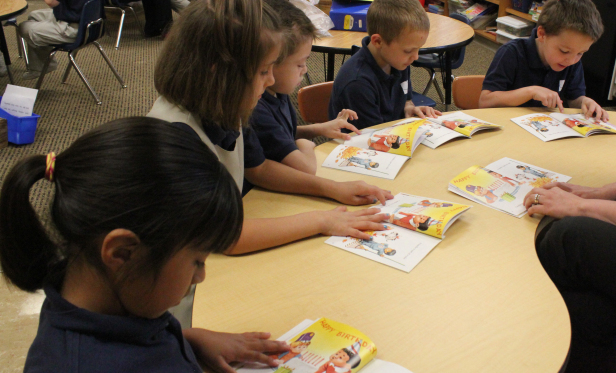
- Student-Selected Combinations
Sit downward. This is a big ane: attempt letting students create groups. Have everyone list ten kids they'd like to read and discuss a volume or several brusque texts with. Match them up like a Sudoku genius. The group tin pitch books to each other, or yous can handle the pitches. This is accurate, the way real book groups work. You see with people with whom you like to talk. Yous agree to read the same thing. You talk most it. Together. And if nosotros teach kids to have a volume group in school, they'll know how to set one upwardly in their personal lives. - Grouping by Potluck/ Group in a Random Mode
I do love a good potluck! When I first started pedagogy, my colleagues and I placed colored tiles in a bag and had students selection from the bag to decide groupings. More simply, students could even just "count off." This is similar to forming heterogeneous groupings, but in this case the groupings would be random rather than teacher-selected. Information technology'south interesting to run into what happens when any (unintentional) teacher bias is removed from grouping. - Grouping by Level
Wait a minute! Isn't the whole betoken of this article to suggest that teachers grouping kids in waysother than by level? Aye, but let's also consider that there are some strengths to this format as long as it'southward not the only strategy nosotros use. When students are struggling, finding a practiced text lucifer is essential. When I work with same-level peers, focused work with strategy cues can actually help gear up readers on class.
In short? Change information technology up! Flexible grouping that considers more than reading level will elevate your education. It will aid students develop and refine their identities as readers, and it will increment date and achievement. While I do feel proud when my students "brand their numbers," I am more pleased when they bump into me and tell me nigh what they're reading, when I see them carrying a book in the world, or when their parents email me a photograph of them reading with the caption, "Guess who can't stop reading now?" That's the measure of success that matters, and that'south why I mix up groups.
Later all, reading isn't all about levels. Information technology's about reading, talking, thinking, and connecting with a customs.
 Mary Roderique has been working with readers and writers for over 20 years as a classroom teacher, reading teacher, and literacy staff development consultant. She moved to Michigan for the desirable winter weather condition conditions and is currently teaching Kindergarten in the Ann Arbor Public Schools. Mary and her family also enjoy their work with service and therapy dogs and 826 Michigan.
Source: https://partnershipforinquirylearning.org/5-ways-group-readers-level/
0 Response to "What Are Some Fun Ways to Choose Readers When Reading in Groups"
Post a Comment