Google Auth Not Yet Initialized. Try Again in a Couple Seconds.
Laravel Auth::routes() Email verification Reset password Hallmark Registration routes
php artisan brand:auth, ui, ui:auth in Laravel 6
The second part Office II is the cadre description of Laravel Auth routes for Laravel 6.0, v.8 and older versions. The core of framework related to the "Auth routes" is well-nigh similar in the contempo versions except ones that is about the {hash} of e-mail in the verification link and I described it in Part III (Laravel half dozen Electronic mail Verification Routes).

Also for semantic versioning in Laravel vi read this new article.
For installing Laravel 6 in Ubuntu read this new article and also LAMP stack in Ubuntu.
Part I:
Update Nov 2019: Taylor just released Laravel Installer 2.three.0… added a new " — auth" flag to create a new project with the hallmark scaffolding installed and ready to go!
It means we can do:
laravel new project --auth How to update laravel/installer : read here
It means this command:
laravel new my-exam-app --auth Is the shorthand of iv following commands:
Laravel new my-test-app cd my-test-app composer require laravel/ui --dev php artisan ui vue --auth
See this new article to see the deviation betwixt ui:auth commands
Laravel 6.0 — Update Sep 2019:
You lot might have noticed that after installing a fresh Laravel half dozen application and running this command:
php artisan make:auth This scene!
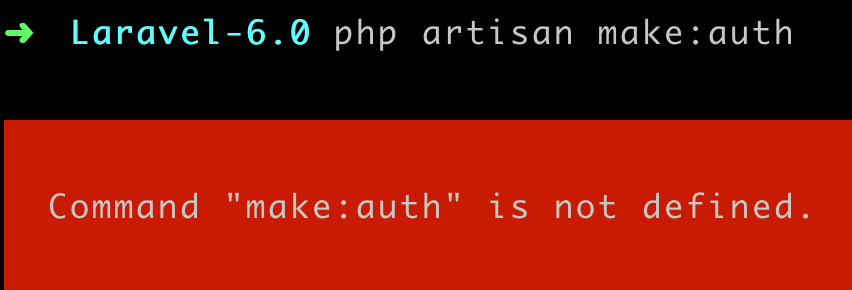
Command "make:auth" is not defined
make:auth command no longer exists! Then I add (Part I) a quick update dedicated for Laravel 6 on generating auth scaffolding in Laravel.
Laravel UI Composer package is a new first-party package that extracts the UI portion of a Laravel project ( frontend scaffolding typically provided with previous releases of Laravel ) into a separate laravel/ui package.
The separate package enables the Laravel squad to update, develop and version UI scaffolding package separately from the main framework and the main Laravel codebase.
Equally a result of this change, no Bootstrap or Vue code is present in default framework scaffolding, and the brand:auth control has been extracted (in version 6 of Laravel) from the framework as well.
In club to restore the traditional Vue / Bootstrap scaffolding present in previous releases of Laravel, you may install the laravel/ui package and use the ui Artisan control to install the frontend scaffolding. I will show you.
Laravel does non dictate which JavaScript or CSS pre-processors you use but it provides a basic starting signal using Bootstrap and Vue. The Bootstrap and Vue scaffolding provided past Laravel is located in the laravel/ui Composer packet, which may be installed using Composer:
Github source of laravel-ui, all presets of laravel ui are hither
Laravel new my-examination-app # composer crave laravel/ui --dev
note: For other kind of ui presets you lot can run into here , tailwindcss
Once you've installed laravel/ui you accept a couple of commands available to generate UI code ( installing the frontend scaffolding), including authorization.
check this help command:
php artisan ui --help or
php artisan assistance ui to run across more options. If you intend to utilise Vue, React, or Bootstrap, the UI parcel provides the post-obit command:
            // Generate basic scaffolding...            php artisan ui              bootstrap
php artisan ui              vue
php artisan ui              react
            // Generate              login              /              registration              scaffolding...            php artisan              ui              bootstrap              --auth
php artisan              ui              vue              --auth
php artisan              ui              react              --auth
And so
php artisan migrate If you apply the control of registration scaffolding y'all volition see:

Then :
            npm install
npm run dev 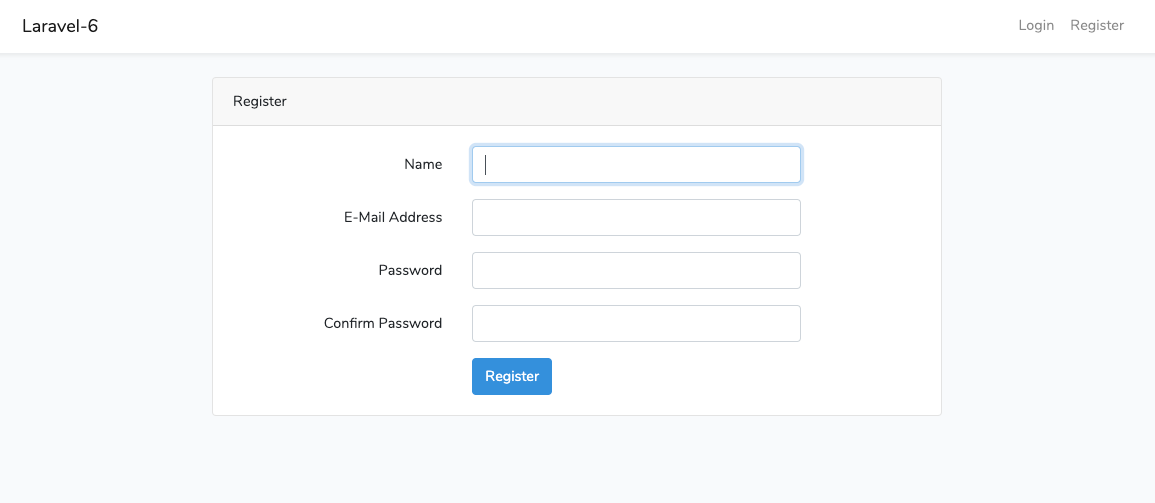
Likewise the new ui command, the laravel/ui package comes with some other command for generating the auth scaffolding:
php artisan ui:auth it will generate the auth routes, a HomeController, auth views, and a app.bract.php layout file.
Y'all tin also generate the views just with:
php artisan ui:auth --views the console command will prompt y'all to confirm overwriting auth files if yous've already run the command before.
See this new article to see the departure between ui:auth commands
Part 2:
Laravel cadre and Auth in Laravel 5.viii and older
After you do this in terminal:
php artisan brand:auth In Laravel five.8 and 5.seven or older, you volition observe this in routes/web.php file:
Auth::routes(); Road::get('/dwelling house', 'HomeController@index');
Auth::routes() volition create some routes by default which are non shown in the routes/spider web.php file.
In fact, Auth::routes() is a helper course that helps you lot generate all the routes required for user authentication.
Auth is a facade and is defined in config/app.php you will find the form that acts equally its provider in that configuration file.
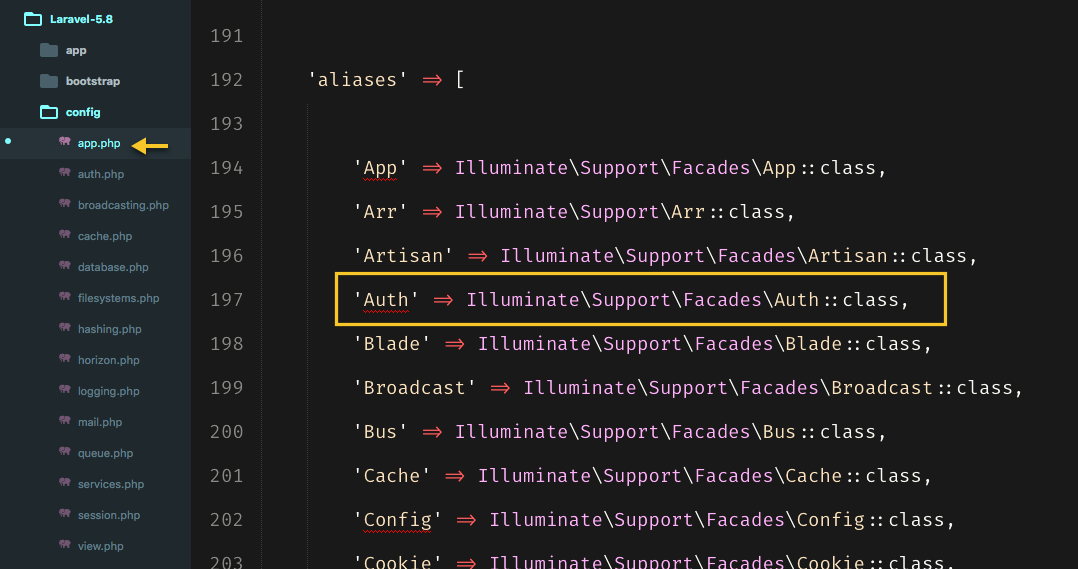
If yous want to make your Sublime Text pretty equally like equally mine read this tutorial !
The Auth::routes() method is in src/Illuminate/Support/Facades/Auth.php or here.
            class              Auth              extends Facade
{
              /**
              * Go the registered name of the component.
              *
              * @render string
              */
              protected static function getFacadeAccessor()
              {
              return 'auth';
              }            /**
              * Annals the typical authentication routes for an application.
              *
              * @param  assortment  $options
              * @return void
              */
              public static function              routes(assortment $options = [])
              {
              static::$app->brand('router')->auth($options);
              }
}
Also you can browse all the routes in Router class in this link here.
In this link or in your local app inside the file src/Illuminate/Routing/Router.php y'all volition notice the routes in line 1149:
            public part auth(assortment $options = [])
              {
//              Authentication Routes...
              $this->go('login', 'Auth\LoginController@showLoginForm')
->name('login');
              $this->post('login', 'Auth\LoginController@login');
              $this->postal service('logout', 'Auth\LoginController@logout')
->proper name('logout');            //              Registration Routes...
              if ($options['annals'] ??              truthful) {
              $this->get('register', 'Auth\RegisterController@showRegistrationForm')
->name('register');
              $this->post('annals', 'Auth\RegisterController@register');
              }            //              Countersign Reset Routes...
              if ($options['reset'] ??              true) {
              $this->resetPassword();
              }            //              Electronic mail Verification Routes...
              if ($options['verify'] ??              fake) {
              $this->emailVerification();
              }
              }
In the below screenshot you may come across amend:
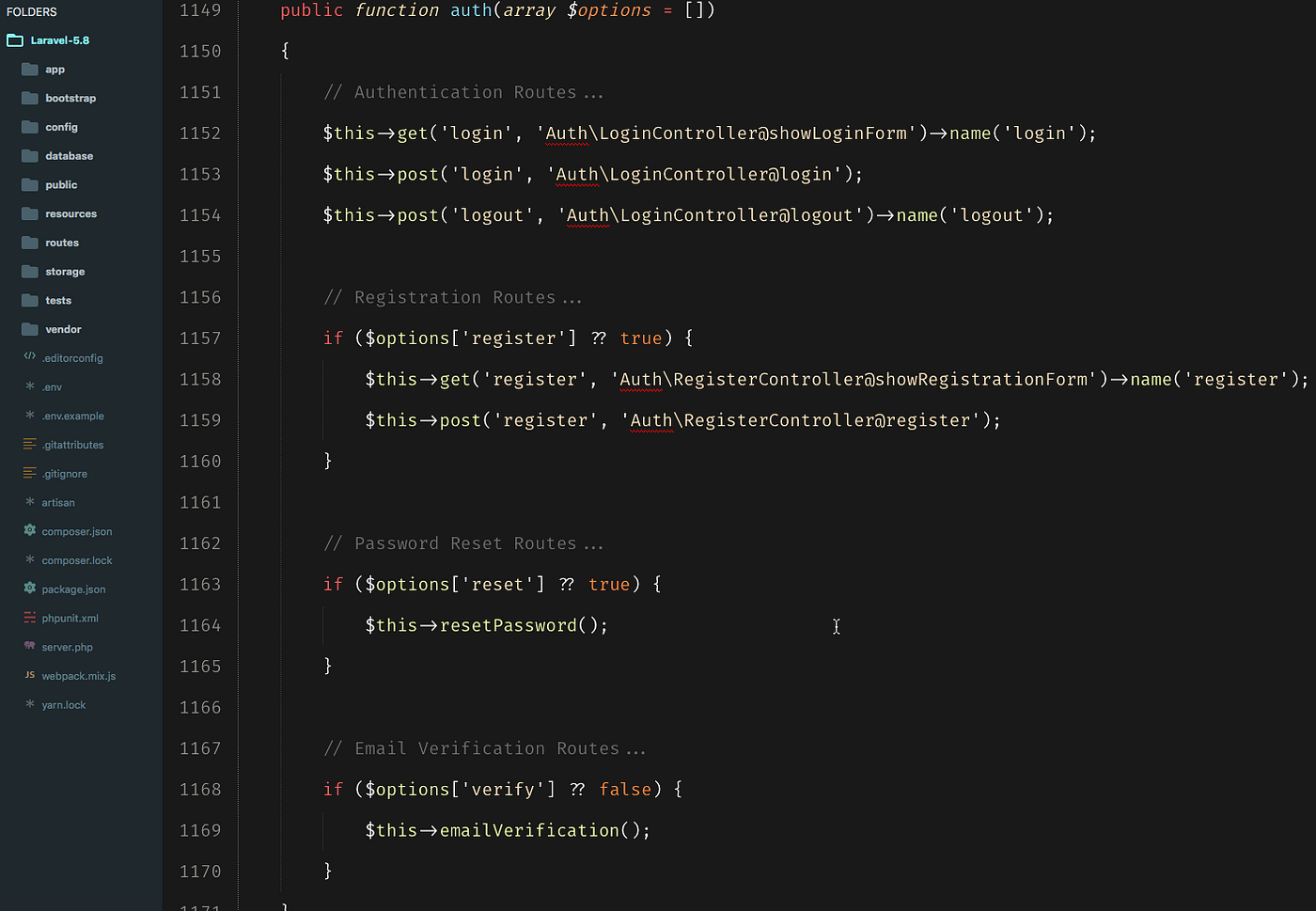
As you can meet above for the Registration, Password Reset and besides Email Verification Routes there are if statements which by default is set false for only Email Verification Routes section.
Information technology ways this line:
$this->emailVerification(); won't exist run past default in Laravel 5.7 and 5.eight.
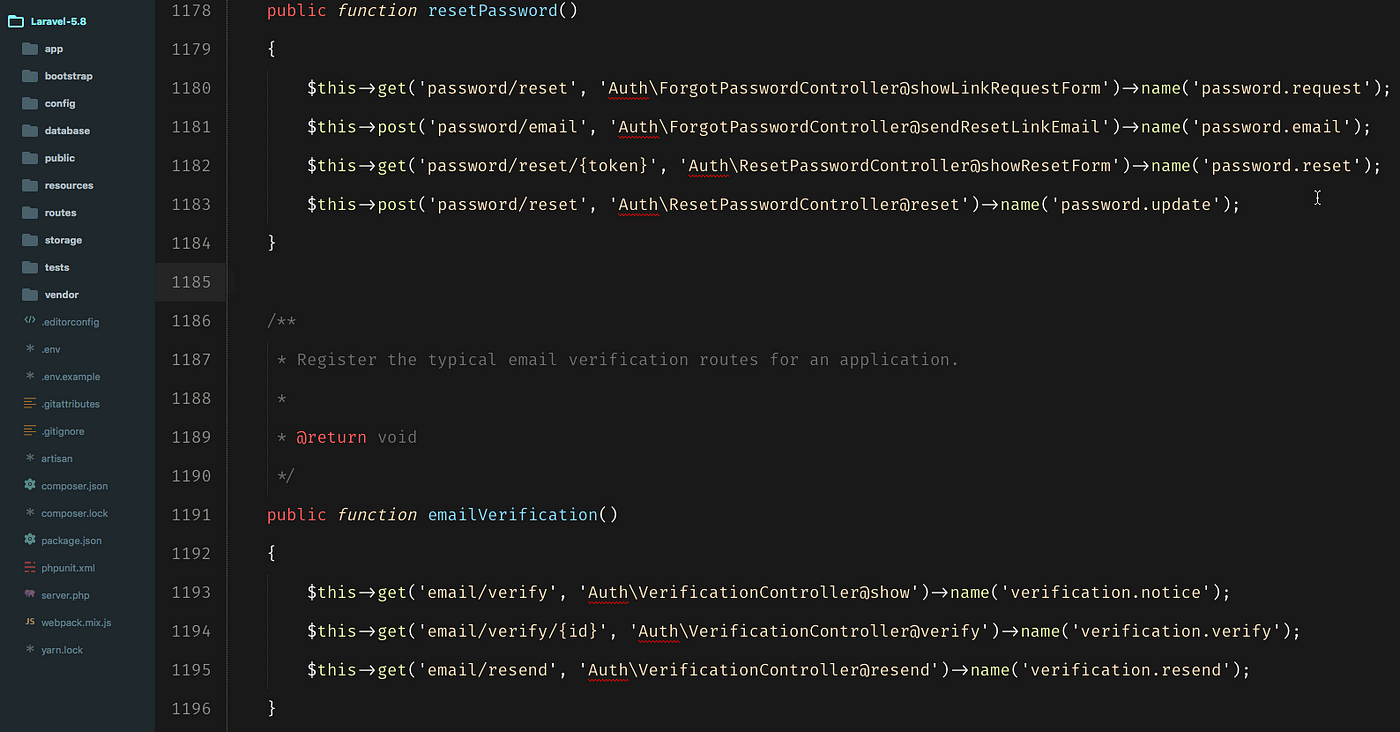
And as well in line 1178 y'all will meet the other remained routes:
            public role              resetPassword()
              {
              $this->get('password/reset', 'Auth\ForgotPasswordController@showLinkRequestForm')->proper name('password.asking');
              $this->mail service('password/e-mail', 'Auth\ForgotPasswordController@sendResetLinkEmail')->name('password.email');
              $this->get('password/reset/{token}', 'Auth\ResetPasswordController@showResetForm')->name('password.reset');
              $this->post('countersign/reset', 'Auth\ResetPasswordController@reset')->name('countersign.update');
              }
public function              emailVerification()
              {
              $this->go('email/verify', 'Auth\VerificationController@show')->name('verification.notice');
              $this->go('email/verify/{id}', 'Auth\VerificationController@verify')->name('verification.verify');
              $this->get('email/resend', 'Auth\VerificationController@resend')->name('verification.resend');
              }
Or encounter amend here:
If you want to list all the active road you tin exercise this in terminal :
php artisan route:listing php artisan road:list --compact php artisan route:listing -c php artisan route:listing | grep register # for mac and linux php artisan route:list | findstr register. # for windows
The screenshot blare is an example:

You can also filter the routes via
            php artisan route:list --proper name=
php artisan road:list --path=
php artisan route:list --method= 
I hope to publish ii other manufactures near some more technical facts behind the Laravel authentication and how to integrate Laravel authentication with other services, like telegram Stay tuned!
Note 1:
Laravel includes the Auth\VerificationController grade that contains the necessary logic to send verification links and verify emails.
In order to get benefits of preset Electronic mail Verification Routes in Laravel five.7 or 5.eight yous should annals (only activate the routes) the necessary routes for this controller just by passing the verify pick to the Auth::routes method like:
Auth::routes(['verify' => true]); Note 2:
Also If you want to change some routes you tin overwrite them past inserting but i or some of the in a higher place routes inside the routes/spider web.php file.
Maybe you need to delete this totally:
Auth::routes(); and first from scratch and put all of your custom routes inside the body of this part :
Route::group(['middleware' => ['web']], function() { });
Although out of the box, the web middleware group is automatically applied to your routes/web.php file by the RouteServiceProvider. And in that location is no need to use the 'middleware' => ['web'].
Note 3:
In laravel v.7 / v.viii instead of using:
Auth::routes(['verify' => truthful]); you can utilize this:
Auth::routes(); and and then manually insert these in routes/web.php
            Route::get('email/verify', 'Auth\VerificationController@show')
->name('verification.find');
Route::get('email/verify/{id}', 'Auth\VerificationController@verify')->name('verification.verify');
Route::get('email/resend', 'Auth\VerificationController@resend')
->proper noun('verification.resend');
Part III:
Laravel 6 Electronic mail Verification Routes
Take a look at line 1194 here in /src/Illuminate/Routing/Router.php in Laravel half-dozen, you can see a deviation with Laravel 5.8 here.
As I showed you in Part Two, just by passing the verify option to the Auth::routes:
Auth::routes(['verify' => truthful]); some of the default routes which are necessary for authenticating user go active. Part of these routes are institute here : These are responsible for sending activation link and also verifying user's electronic mail. In Laravel 6, in that location is a second route parameter which is {hash}.
A link containing this hash is sent to the user. Let's run across the progress:
As soon every bit a user is registered this listener (SendEmailVerificationNotification.php) is triggered:
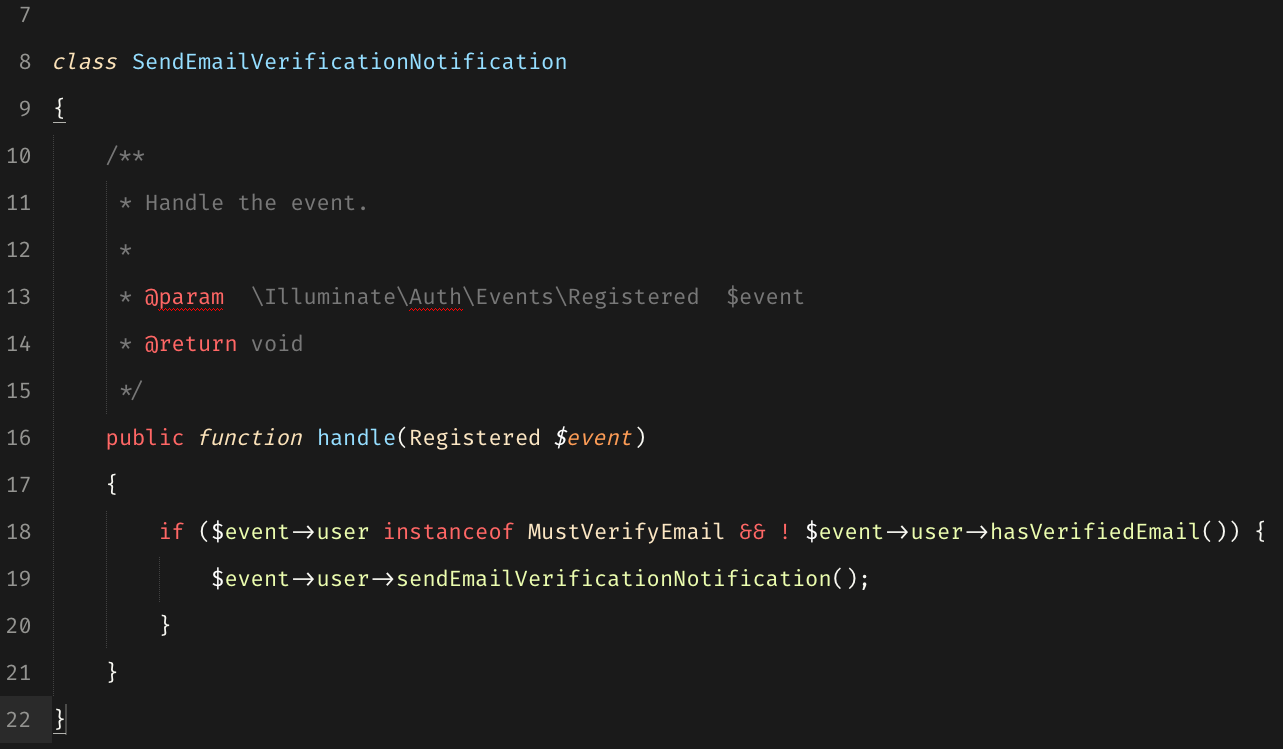
and If the User model implements the MustVerifyEmail trait (read here function Model Grooming) and user record does not have value for this field email_verified_at however (it means user is not activated) then this notification method: sendEmailVerificationNotification() is permitted to run. This notification method is found in MustVerifyEmail trait.

So information technology seems the VerifyEmail class is responsible for making the electronic mail verification link and sending it to the user. Allow's look at it.
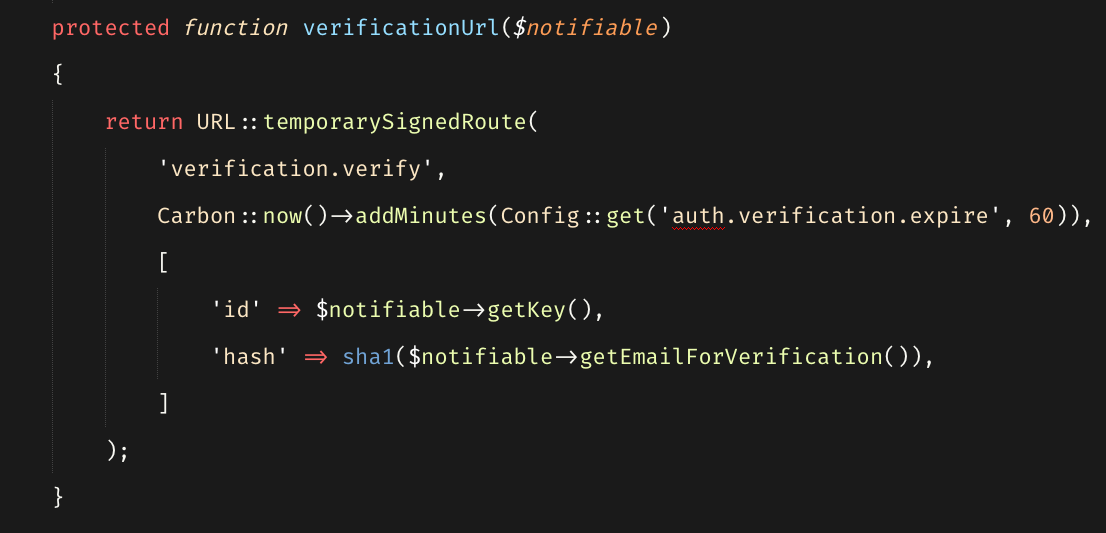
You come across the email verification URL is made in the format of Laravel Signed URLs. The end office of the verification link is composed of user's id and likewise the sha1 of user's e-mail address, remember we demand these route parameters: electronic mail/verify/{id}/{hash}
Allow's find how Laravel verifies this link when the user click on it.
If you activate the default laravel routes past using:
Auth::routes(['verify' => true]); And so VerificationController course and the VerifiesEmails trait are doing the residue jobs. See the verify() method in VerifiesEmails trait.
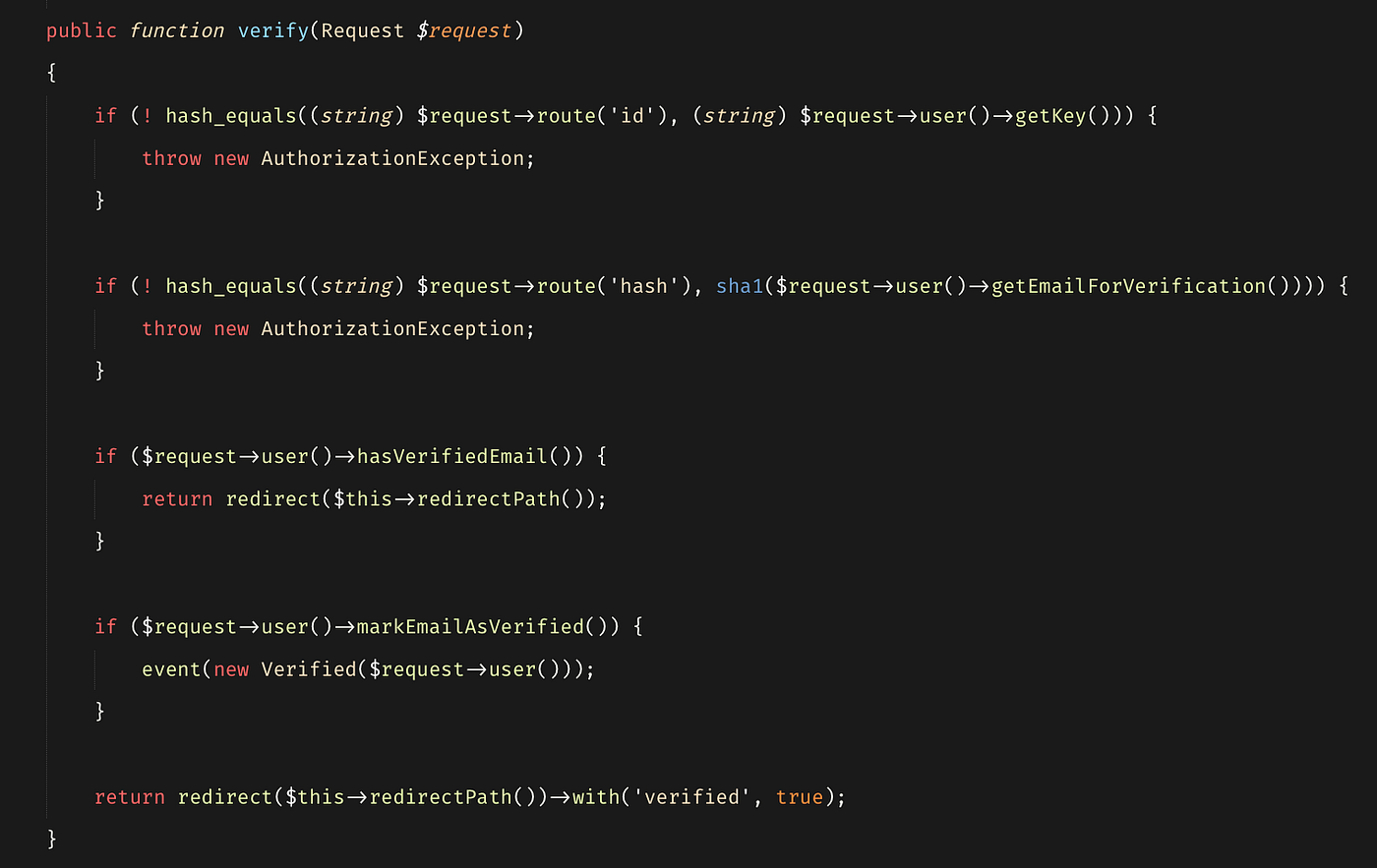
In the second part you run across Laravel make over again the sha1 format of user'south electronic mail address and so compare information technology(hash_equals) with what the line has (road parameter: route('hash').
This is what y'all can not encounter in older version of Laravel.
Attention: In order to get the authenticated user you see this is used:
$asking()->user() This is considering of user is permitted to verify the electronic mail when she/he is logged in. You can see VerificationController uses this middleware:
$this->middleware('auth'); If you are using default Laravel Authentiation and verification Email organization equally I described above and want to restrict users if they don't have a verified email y'all demand to apply the post-obit middleware for each route:
EnsureEmailIsVerified.php
Have a look at the Kernel.php file and in protected $routeMiddleware array you lot will discover this line:
'verified' => \Illuminate\Auth\Middleware\EnsureEmailIsVerified::class, It ways as like as yous may utilize in __construct() of whatever controller
$this->middleware('auth'); you tin as well use 'verified' to ensure that user must have a verified electronic mail to access a route.
$this->middleware('verified'); I volition update this postal service gradually.
Thank you for reading! If you enjoyed this article:
Clap it ! Share it! Follow Me in Medium!
Also I'd like to hear your opinion on this article. If you have any doubtfulness, question or suggestion please leave a comment below.
Have a very wonderful day!
Previous Stories You will Beloved:
Source: https://panjeh.medium.com/laravel-auth-routes-email-verification-reset-password-authentication-registration-routes-fb82b3337150
0 Response to "Google Auth Not Yet Initialized. Try Again in a Couple Seconds."
Post a Comment